


Corrected: In the field of electronic packaging, alumina ceramic substrates, owing to their excellent insulation, thermal conductivity, and mechanical strength, serve as the foundational material for thick-film circuits, thin-film circuits, and high-precision electronic devices.
As electronic devices trend towards miniaturization, high power, and high frequencies, the performance requirements for alumina substrates are increasingly demanding. Grain refinement and densification have emerged as the two core process routes for enhancing the performance of alumina substrates. Understanding the connotations, differences, and connections between these two concepts is of great significance for optimizing preparation processes and obtaining high-performance substrates.
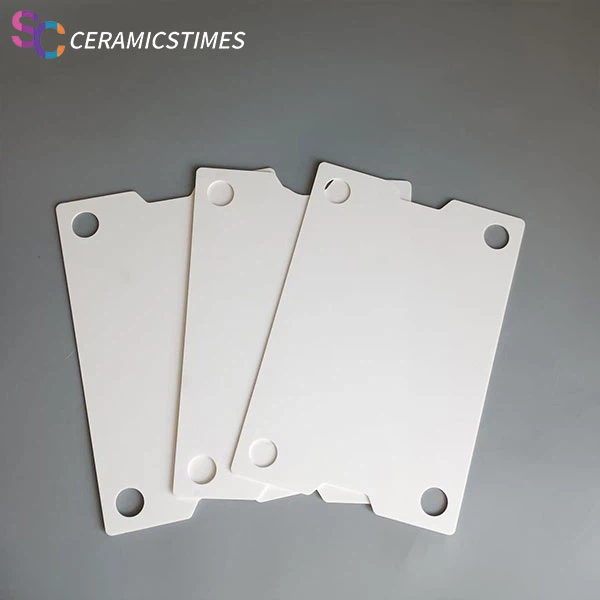
The Connotation and Significance of Grain Refinement
Grain refinement refers to reducing the size of grains within the ceramic material. Finer grains generally lead to higher strength, hardness, and toughness. The principle behind this is the Hall-Petch relationship: the strength of a material is inversely proportional to the square root of the grain size. More grain boundaries enhance the ability to hinder crack propagation. For alumina substrates, the significance of grain refinement is manifold:
Improving Mechanical Strength: By optimizing the process to control the average grain size of the alumina substrate to around 1.1 μm, its flexural strength can reach (440 ± 25) MPa, significantly enhancing the substrate's resistance to damage.
Enhancing Surface Finish: Finer grains result in a surface roughness (Ra) that can reach the nanometer level after polishing. This is crucial for the adhesion of thick-film and thin-film circuits, especially in high-frequency and high-precision circuit applications.
Reducing Dielectric Loss: A fine-grained structure typically implies fewer grain boundary defects, which helps reduce the attenuation of high-frequency signals during transmission.
The Difference and Connection Between Grain Refinement and Densification
The core difference between the two lies in their research object and level of action. Grain refinement is an optimization of the microstructure, aimed at making grains finer and more uniform, thereby enhancing mechanical properties and surface quality. Densification is the improvement of the physical state, aimed at eliminating internal pores within the ceramic, thereby enhancing thermal, electrical properties, and reliability.
During the ceramic sintering process (the process of heating powder into a dense body), grain refinement and densification occur simultaneously yet compete with each other.
Ideal Scenario: Achieving complete densification before grain growth occurs, resulting in a "fine-grained + fully dense" structure.
Practical Contradiction: High-temperature sintering, while beneficial for densification, can easily lead to grain coarsening. Conversely, low-temperature sintering, while inhibiting grain growth, may leave pores that affect thermal conductivity and insulation properties.