

Hey there! As a supplier of ceramic grinding discs, I often get asked about the cost of customizing these discs. It's a question that doesn't have a one - size - fits - all answer, and in this blog, I'll break down the various factors that influence the cost of customizing a ceramic grinding disc.
Material Costs
The first and most obvious factor is the material used in the ceramic grinding disc. Different ceramic materials come with different price tags. For example, high - performance ceramics like Aluminum Nitride Ceramic Heaters are known for their excellent thermal conductivity and high - temperature resistance. These materials are more expensive compared to standard alumina ceramics.
Alumina oxide ceramics, on the other hand, are more commonly used and are relatively more affordable. However, if you need a specific grade of alumina with enhanced properties, such as higher purity or better wear resistance, the cost will go up. The Alumina Oxide Ceramics Vacuum Sucker is an example of a product that might use a specialized alumina ceramic, and the cost of the material for such a product can impact the overall cost of customizing a grinding disc.
Design Complexity
The design of the ceramic grinding disc also plays a huge role in determining the cost. A simple, standard - shaped disc with basic features will be much cheaper to customize than a disc with a complex design. For instance, if you need a disc with intricate patterns, special grooves, or non - standard shapes, the manufacturing process becomes more difficult and time - consuming.
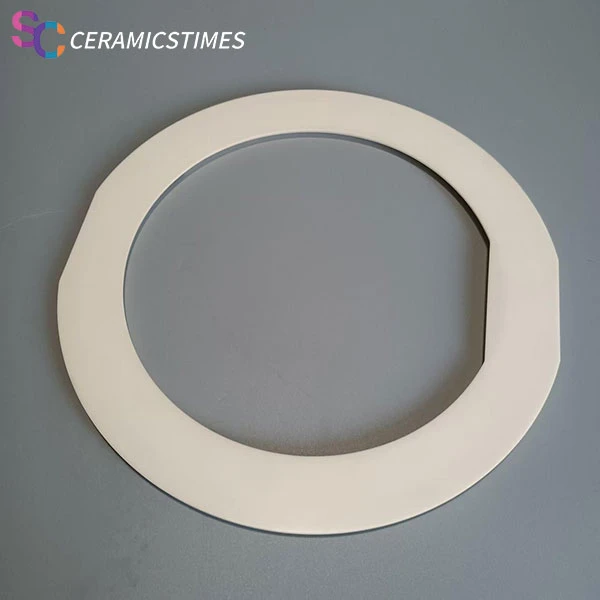
Let's say you want a grinding disc with a unique edge profile, similar to the Edge Ceramic Ring. Creating such a custom edge requires precision machining and specialized tools, which adds to the cost. The more complex the design, the more labor and resources are needed, and thus, the higher the cost.
Production Volume
Production volume is another crucial factor. Generally, the more ceramic grinding discs you order, the lower the cost per unit. This is because of economies of scale. When producing a large quantity, the fixed costs of setting up the production line, such as tooling and equipment calibration, can be spread over a larger number of units.
For example, if you only need a small batch of custom - made grinding discs, the cost per disc will be relatively high. But if you place a large order, the cost per disc will decrease significantly. So, if you're planning to use a large number of ceramic grinding discs in your operations, it's more cost - effective to order in bulk.
Quality Requirements
The quality requirements for the ceramic grinding disc also affect the cost. Higher quality standards mean more rigorous testing and inspection processes. For example, if you need a grinding disc with a very tight tolerance on its dimensions, the manufacturing process has to be more precise.
This might involve using more advanced manufacturing techniques and better - quality raw materials. Additionally, quality control measures such as non - destructive testing and surface finish inspection add to the cost. If you're in an industry where high - quality grinding discs are essential for safety or performance reasons, you'll have to pay more for the added quality assurance.
Additional Features
Sometimes, you might want to add extra features to your ceramic grinding disc. This could include things like a special coating for better wear resistance, or an embedded sensor for monitoring the grinding process. These additional features come at a cost.

For example, applying a high - performance coating requires additional materials and a specialized coating process. The cost of the coating material itself, as well as the labor and equipment needed to apply it, will increase the overall cost of the customized grinding disc.
Market Conditions
Market conditions can also have an impact on the cost of customizing a ceramic grinding disc. Fluctuations in the prices of raw materials, such as ceramic powders and additives, can cause the cost to go up or down. Additionally, competition in the market can influence the pricing.
If there are many suppliers offering similar products, the prices might be more competitive. On the other hand, if there is a shortage of a particular raw material or if there is high demand for custom - made ceramic grinding discs, the prices are likely to increase.
Conclusion
So, as you can see, the cost of customizing a ceramic grinding disc is influenced by a variety of factors, including material costs, design complexity, production volume, quality requirements, additional features, and market conditions. It's important to carefully consider these factors when deciding on the customization options for your ceramic grinding disc.
If you're interested in customizing ceramic grinding discs for your specific needs, I'd be more than happy to discuss the details with you. We can work together to find the best solution that fits your budget and requirements. Don't hesitate to reach out and start a conversation about your procurement needs.
References
- Industry reports on ceramic materials and manufacturing costs
- Internal company data on custom ceramic grinding disc production