


Advanced ceramics have attracted widespread attention due to their high strength, wear resistance, corrosion resistance, high hardness, high-temperature resistance, and other properties, as well as their outstanding performance in fields such as optics, electricity, acoustics, and magnetism. They have become foundational and key materials in industries including aerospace, aviation, construction, electronics, metallurgy, machinery, chemicals, and biology, possessing broad market prospects and extremely important strategic value. Currently, the global advanced ceramics sector is showing a trend of rapid technological development, continuous expansion of application scope, and steady growth in market size.
Semiconductor Precision Ceramics: An Accelerating Zone for Domestic Substitution
As a key upstream material in the industrial chain, the market demand growth pattern for precision ceramics is roughly synchronized with the growth of the semiconductor and semiconductor equipment markets.
China's semiconductor equipment market size was US$18.72 billion in 2020, grew to US$36.6 billion in 2023, and reached US$49.55 billion in 2024. In terms of market share, China's share of the global semiconductor equipment market climbed from only about 6% in 2006 to first place globally in 2020 (26%), and continued to expand to about 42% in 2024, with China firmly holding its position as the world's largest single market. With the explosive growth of AI computing demand, wafer fab capacity expansion, and accelerated domestic substitution, China's semiconductor equipment market continues to expand.
It can be seen that China has become the largest application market for precision ceramics, with the fastest demand growth and enormous market capacity.
In 2026, the recovery trend of the global semiconductor industry chain is clear, and demand growth for precision ceramic components upstream of chip equipment is rising in tandem. As essential supporting consumables for wafer production lines, ceramic components' order activity directly reflects chip manufacturing enterprises' long-term capacity expansion plans. Kyocera CEO Shiro Tomoshima stated that industry growth has long-term underlying support, and the market will not quickly decline with short-term chip price fluctuations; the prosperous window will last until 2030.
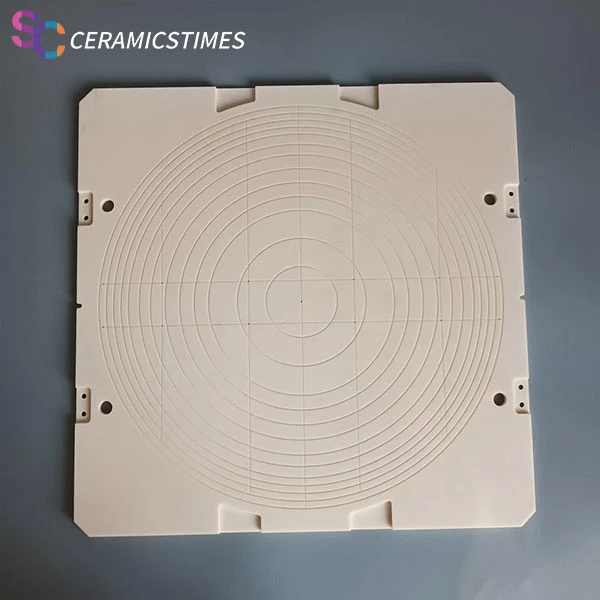
For example, in recent years, domestic localization of advanced structural ceramics has mainly focused on relatively simple structural components. However, what is truly "bottlenecked" in wafer fabs are "function-structure" integrated modules such as ceramic heaters and electrostatic chucks. They must not only withstand plasma corrosion but also achieve precise temperature control and electrostatic adsorption under extreme temperature differences, directly determining the uniformity of thin-film deposition and etching yield.
The global ceramic electrostatic chuck market shows obvious high concentration characteristics. Japanese companies form the world's core supply cluster, while specialized companies in South Korea and the United States occupy important positions in specific material systems, equipment platforms, and regional customers. In recent years, China's market has gradually formed local supply forces such as Junyuan Electronics, Beijing Huazhuo Jingke, Suzhou Kema, and Wuxi Haigude, and has begun to make continuous breakthroughs in 12-inch high-end products, etching ESCs, and multi-zone temperature control products.
AI: Ceramic Solutions Forced into Being
Everyone knows how hot AI is right now.
The first is ceramic substrates, especially aluminum nitride ceramic substrates. The reason for this demand growth is more direct than in semiconductors: not enough power, heat that cannot be dissipated, and traditional solutions have reached their limit.
A new round of global AI technology explosion has driven a surge in computing demand. In the AI computing field, as AI applications enter the large-scale inference stage, the heat brought by high power consumption is pushing traditional cooling solutions to their ceiling. High-thermal-conductivity aluminum nitride ceramic substrates (thermal conductivity can reach 170-200 W/(m·K), second only to silicon carbide and diamond among ceramic materials) have become indispensable strategic foundational materials in the AI computing field due to their disruptive heat dissipation performance and thermal matching with silicon chips.
After adopting aluminum nitride ceramic substrates, the junction temperature of optical chips can be controlled below 60°C, and heat dissipation efficiency is more than 5 times higher than that of traditional substrates. At the signal transmission level, aluminum nitride substrates can achieve high-precision routing of differential signals, with transmission loss reduced by 40% compared with FR-4 substrates, meeting the stringent requirements for long-distance transmission in data centers.
While demand is exploding, the supply side has suffered a fatal contraction. During the high-temperature sintering process of aluminum nitride ceramic substrates, high-purity yttrium oxide must be added as a key additive, and 93% of the world's yttrium oxide production capacity is concentrated in China.
With the implementation of China's rare earth export controls, Japanese manufacturers that have long monopolized the global high-end aluminum nitride market instantly fell into a "no rice to cook" situation. Japan's Tokuyama, the global leader in high-end powders, holds a 75% market share, while substrate giant Kyocera's yttrium oxide inventory is only enough to last 10-15 days. Facing raw material supply cuts, Kyocera was forced to reduce high-end substrate capacity by 25%-30%, partially halt 1.6T and CPO production lines, and even suspend accepting new overseas orders, causing overseas order delivery cycles to lengthen to more than half a year.
The proactive contraction of overseas giants has left a clear "window period" for the domestic industrial chain. China Electronics Technology Group Corporation's CETC has become one of only two companies in the world capable of stable mass production of 1.6T aluminum nitride thin-film substrates, with product yield stable at above 95%. KeXiang Co., Ltd. is ceramic mixed-pressure PCB research and development to adapt to the high-density wiring and heat dissipation needs of AI servers; Fuled expands its DPC ceramic carrier board business through subsidiaries, entering the AI server power device packaging supply chain. The application boundaries of high-end ceramic substrates in AI computing infrastructure continue to broaden.
The second is MLCC, especially high-end MLCC. When the industry focuses on computing chips such as GPUs and HBM, the tiny MLCC is becoming an indispensable core passive component for the stable operation of AI servers.
Industry data shows that the MLCC usage per AI server is about more than 10 times that of ordinary servers, and a single server rack can carry up to about 600,000 MLCCs. Murata predicts that by 2030, MLCC demand related to AI servers will grow 3.3 times compared with 2025, with an average annual growth rate maintained at above 30%. The strategic position of MLCC follows closely behind GPUs and high-speed memory, becoming the "vital point" for the stable operation of AI computing.
Since the beginning of this year, the global MLCC price increase wave has continued to ferment, gradually spreading from high-end AI categories to all categories. Murata, Taiyo Yuden, and Samsung Electro-Mechanics have raised prices in succession, with cumulative increases for high-end products reaching as high as over 50% and increases for all categories reaching as high as 30%. At present, lead times for high-end MLCCs have lengthened from the conventional 2 months to 12-16 months. Even with continuous price increases, leading manufacturers still cannot guarantee delivery, and the industry price increase cycle has been established.
As Japanese and Korean manufacturers concentrate capacity on high-end tracks, mid- and low-end and automotive-grade orders continue to spill over, bringing substitution opportunities for domestic manufacturers. After years of industrial investment, domestic MLCC manufacturers have achieved large-scale mass production and market substitution in medium- and low-voltage, conventional-capacitance consumer-grade products. However, for high-grade MLCCs with dielectric layers of 0.5 μm and below, thousand-layer high capacitance, automotive-grade and server-grade products, the industrial chain still has obvious shortcomings.
Bioceramics: A Certain "Long Slope and Thick Snow"
Compared with the explosive rhythm of the first two fields, the growth rate of bioceramics is not stunning, but it is stable and has high barriers.
The global biomedical ceramics market was about US$3.2 billion in 2025 and is expected to reach US$5.72 billion by 2034, with a compound growth rate of 6.68%. Orthopedics is the largest segment, with rigid demand for the wear resistance and biocompatibility of zirconia and alumina ceramics in hip and knee replacement; dental zirconia blocks benefit from increasing implant dentistry penetration and consumption upgrading. The Asia-Pacific region is the fastest-growing region, with a compound growth rate of 7.2% to 7.8%, and the expansion of medical infrastructure in China and India is the main driving force.
Among them, zirconia is one of the core raw materials for biomedical ceramics (such as dental restorations and artificial joints). From the perspective of medical demand for dental materials, global aging continues to advance, and oral restorations such as crowns and dentures are rigid medical needs.
Japan's Tosoh Corporation was forced to suspend zirconia powder supply in June 2026-it was once a benchmark supplier in the global dental restoration field. The main reason is that China implemented export controls on rare earth yttrium. Yttrium oxide is an indispensable stabilizer for making high-end dental zirconia. Without yttrium oxide, high-quality, high-transmittance, high-strength dental zirconia powder cannot be produced.
For many years in the past, the global high-end dental zirconia market was monopolized by Japanese companies for a long time, with Tosoh and Daiichi Kigenso Kagaku Kogyo collectively controlling 50%-70% of the share. Tosoh alone had an 18% share of the global high-end nano zirconia powder market and as much as 40%-45% in the dental-specific powder segment.
China Merchants Securities believes that disturbances in overseas high-end zirconia powder supply and tightening supply of key stabilizers such as yttrium oxide have led the market to reassess the substitution space for domestic enterprises in dental zirconia, yttria-stabilized zirconia powder (YSZ), electronic ceramics, and SOFC materials. At present, Sinocera Material has mastered the mass production technology of high-end zirconia powder by the hydrothermal method and also has stable, low-cost access to yttrium oxide raw materials; its products have entered the downstream ceramic block and oral restoration supply chain. Enterprises such as Kaisheng Technology and Orient Zirconic are accelerating the layout of nano zirconia applications in solid electrolytes.