


With the rapid advancement of technology, AR glasses, as a key device bridging the virtual and real worlds, are gradually integrating into people's lives. From consumer-grade applications such as immersive video watching and gaming to professional fields including industry, healthcare, and education, the AR glasses market is showing robust growth. The large-scale adoption of the AR industry today relies on a set of mature and highly compatible optical materials. Among them, traditional optical glass, resin, and silicon carbide play core roles, each contributing crucially to different technical pathways.
Silicon carbide, already widely used in power semiconductors as an advanced material, is now beginning to enter the field of AR glasses. It offers four major advantages for AR glasses: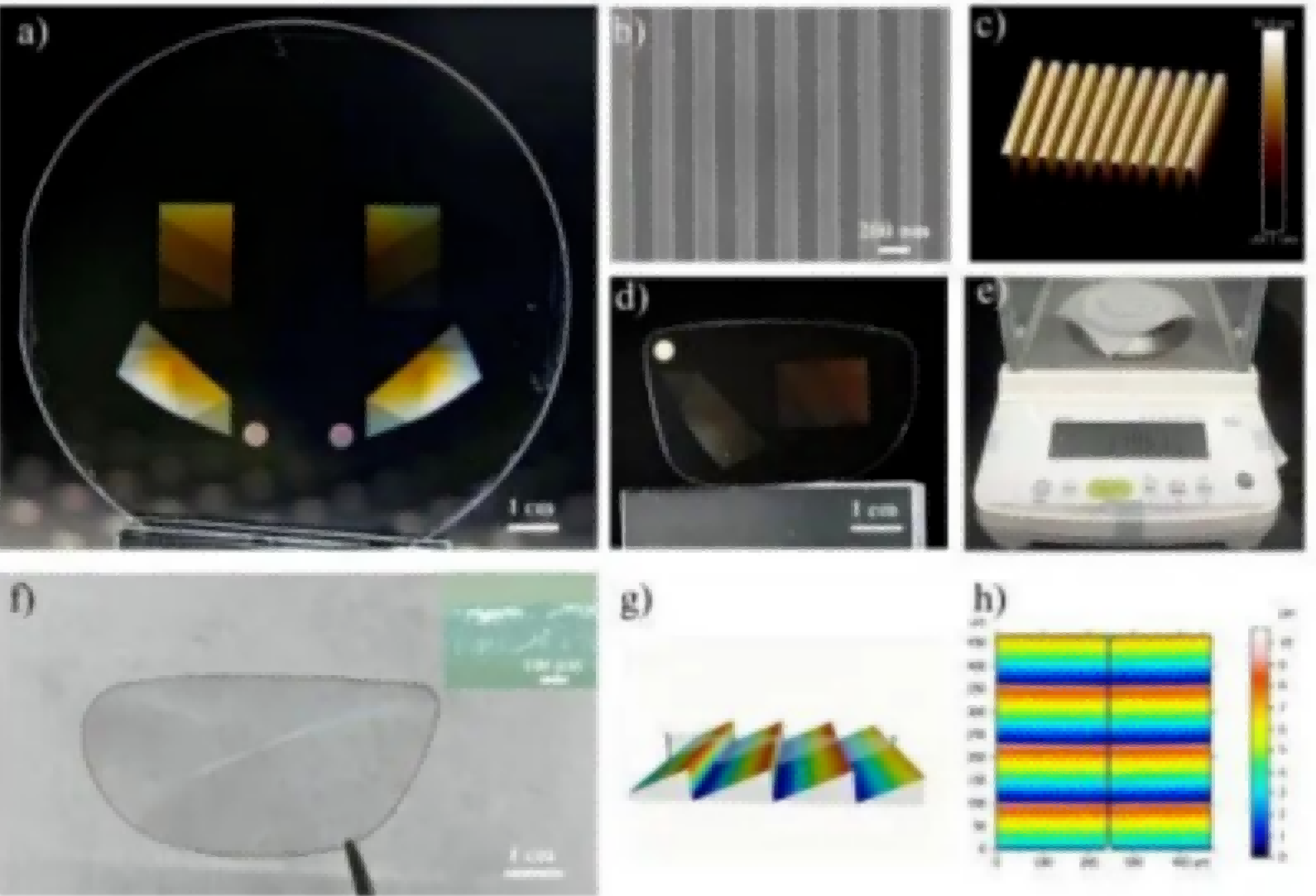
1. Achieving a larger field of view (FoV). With a refractive index exceeding 2.6, a single-layer silicon carbide lens can achieve an FoV of over 80 degrees.
2. Helping to resolve the rainbow artifact issue. The high refractive index of silicon carbide reduces the effective wavelength of light in the material, thereby decreasing the grating period and increasing the diffraction angle of ambient light beyond the range of human eye perception, thus solving the rainbow artifact caused by light splitting.
3. Extending stable battery life. Silicon carbide has a thermal conductivity (~490 W/m·K) far higher than that of traditional optical materials such as glass (~1 W/m·K) and resin. This allows it to quickly dissipate heat generated by the optical engine and computing unit, supporting high-brightness displays and long-term stable operation.
4. Simplifying thermal design. The high thermal conductivity of silicon carbide enables heat dissipation to be integrated into the waveguide itself, meeting cooling requirements through passive means. Additionally, the excellent thermal performance of silicon carbide provides headroom for improving the integration density of AR glasses and accommodating more sensors.
As the product form of AR glasses gradually materializes, related optical solutions are attracting industry attention, and domestic companies are accelerating their layout in materials and processes.